
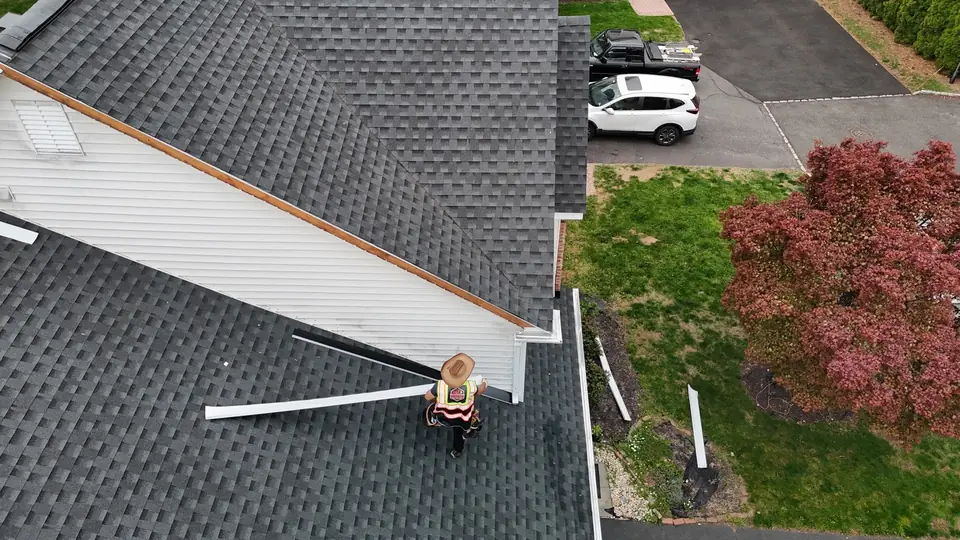
This guide covers one question Manville, NJ homeowners run into with gutters: where the water from each downspout is allowed to go. Our gutter installation page explains how we put up seamless gutters, and our Manville roofing page covers the borough itself, which sits where the Raritan and Millstone rivers meet.
Can downspouts be connected to the sewer in Manville?
No. Section 1 of Manville's Ordinance 2020-1233 says no sump pump or other device that discharges rainwater or ground water, "including but not limited to downspouts," shall be connected to the Borough sanitary sewer system. The ordinance took effect on June 1, 2020.
Why does Manville keep downspouts out of the sewer?
Treatment plant capacity. The ordinance states that the committed flow from Manville to the Raritan Valley Sewage Authority treatment plant is above 80% of its permitted flow.
At that level, New Jersey Department of Environmental Protection rules, N.J.A.C. 7:14A-22.16, call for a program that includes disconnecting roof leaders, sump pumps and other sources of inflow from sanitary sewer lines. A roof leader is the trade name for a downspout.
When does Manville check for a downspout connection?
At a change of hands, and whenever the borough has evidence of an illegal connection. The ordinance sets out two routes:
| Trigger | What the ordinance requires | Time to fix a violation |
|---|---|---|
| Sale, lease, rental or change in occupancy | A certificate of sump pump compliance from the Borough Building Department, applied for at least 10 days before the change. The Zoning Officer inspects the property. | 21 calendar days from the notice of violation |
| Borough Engineer or Director of Public Works finds evidence of an illegal connection | A notice of inspection by certified mail, then an inspection seven or more days later | 14 calendar days from the notice of violation |
Source: Borough of Manville Ordinance 2020-1233, Sections 2 and 4.
Missing the deadline brings daily fines under Section 4, and unpaid charges can become a lien on the property. On a sale, the seller and the new owner are both responsible for compliance.
How do you know if your downspout is connected to the sewer?
Follow each downspout to where it ends. The EPA's Soak Up the Rain program notes that downspouts may be connected to a pipe in the ground that leads directly to the sanitary sewer or the storm drain system. A downspout that drops into the ground instead of ending at a splash block is the one to ask the Borough Building Department about.
Where should downspouts drain instead?
Onto ground that can soak the water up, far enough from the house. The EPA describes downspout disconnection as cutting the downspout away from a pipe or paved area and sending the water to a rain barrel, a lawn or a garden where it can soak into the ground. It also points out that downspouts aimed at a driveway send water straight into the street.
A rain barrel is one way to catch it. Rutgers Cooperative Extension describes the setup plainly: the barrel sits under a gutter's downspout beside the house, and a hose on its overflow drain carries extra water away from the building. Its fact sheet FS1118 also gives distances for rain barrel overflow pointed at a lawn or garden: at least 6 feet from the foundation of a house with a basement, and at least 2 feet for a house with a crawl space.
How much water comes off a roof in a storm?
More than most people picture. Rutgers says about 90% of rain events in New Jersey are 1.25 inches or less, and that a home with an 800 square foot roof drains about 600 gallons in a 1.25-inch storm.
The same fact sheet puts an average rain barrel at 50 gallons. One barrel holds a fraction of what that storm sheds, so its overflow still needs a place to go. Rutgers also says to keep a screen on every opening against mosquitoes, and to set the barrel on level ground, since a full 55-gallon barrel weighs about 460 pounds.
What does this mean for a new gutter installation in Manville?
The downspouts get planned before the gutters go up. On a gutter job we look at roof pitch, roof area and where the downspouts can drop before the first cut. We run oversized 3 by 4 inch downspouts, with splash blocks at the exits to carry the water away from the foundation.
The gutters are seamless aluminum, formed at your house and cut to the length of each eave, with hidden hangers every 24 inches and a slight fall toward each downspout. If your old downspouts run into pipes in the ground, ask the Borough Building Department where those pipes lead before the new layout is settled.
Downspout rules in Manville: questions homeowners ask
Can you run a downspout into the sewer in Manville?
No. Manville Ordinance 2020-1233 bars downspouts, sump pumps and any other rainwater or ground water drain from the borough's sanitary sewer system. The borough inspects for these connections when a home is sold, leased, rented or changes occupants, and when it has evidence of an illegal connection.
How far from the house should a downspout drain?
Rutgers Cooperative Extension gives these distances for rain barrel overflow aimed at a lawn or garden: at least 6 feet from the foundation of a house with a basement, and at least 2 feet for a crawl space. The EPA notes that water sent onto a driveway runs to the street instead of soaking in.
Do I need a certificate to sell a house in Manville?
Yes. Before a sale, lease, rental or change in occupancy, the owner needs a certificate of sump pump compliance from the Borough Building Department, applied for at least 10 days ahead. It confirms that nothing draining rainwater or ground water, downspouts included, is tied into the sanitary sewer.
The short answer
In Manville, NJ, downspouts can't tie into the sanitary sewer, and the borough checks for it at every sale and rental. New gutters should send the water away from the foundation onto ground that can take it. To plan gutters and downspouts for your house, call Spartan Roofing at (973) 938-2776 for a free inspection.
Sources: Borough of Manville, Ordinance 2020-1233 (sump pump inspections and the ban on sanitary sewer connections); U.S. EPA, Soak Up the Rain: Disconnect / Redirect Downspouts; Rutgers Cooperative Extension, Fact Sheet FS1118, Rain Barrels Part II: Installation and Use. All read November 26, 2026.